From GALLO MATESE: The Mountain Town That Never Really Left. The whole opening, as it stands in the book — not a teaser.
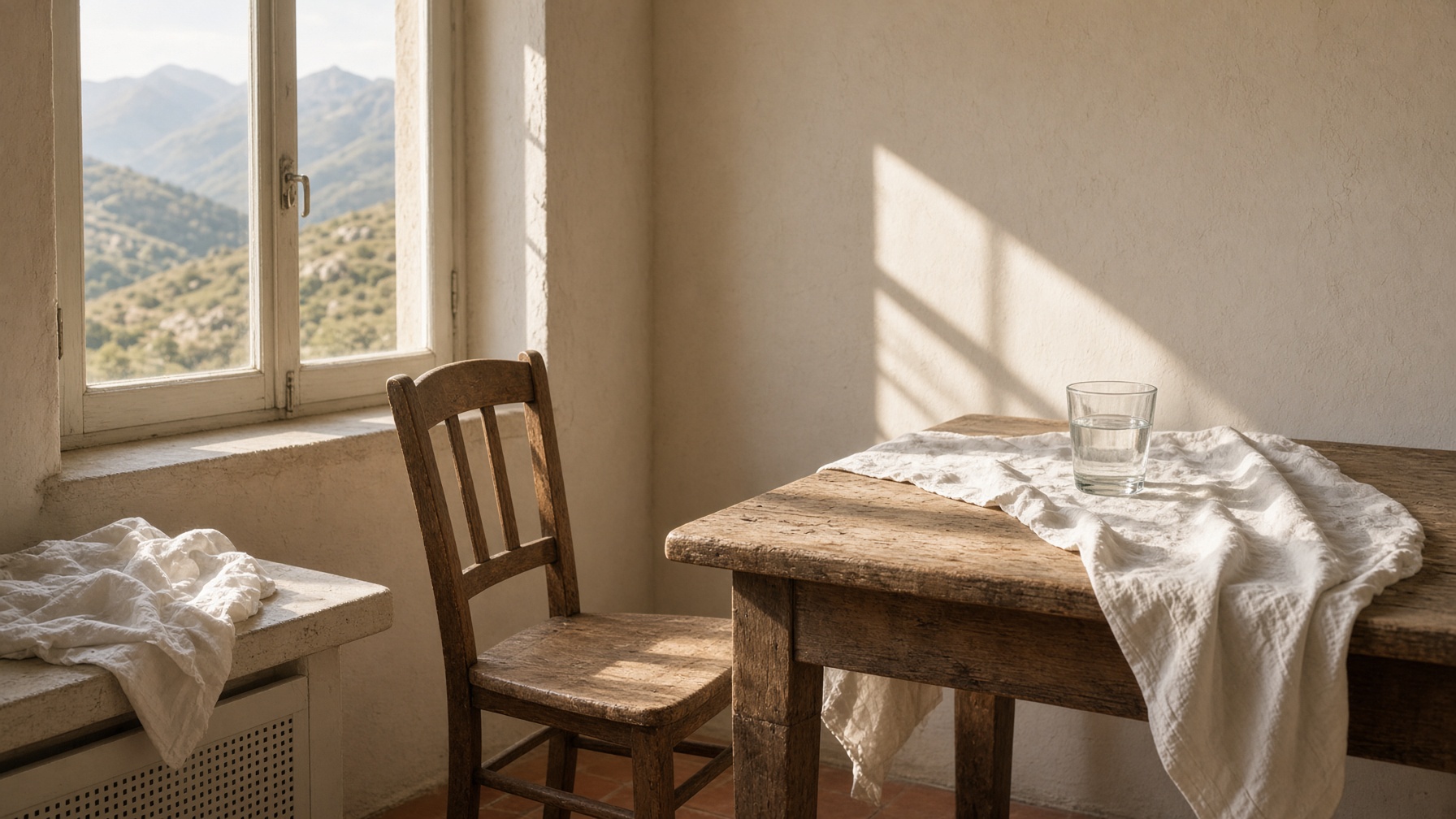
On Sunday, our table is set for one more person than will come.
Nobody announces it. A plate goes down beside the baked pasta. A tumbler waits near the bread. Someone folds a napkin and puts it at the end, where the kitchen light thins across the tablecloth. The habit is older than the people sitting there. Habits are the most durable form of geography.
That chair belongs to someone three thousand miles away, or to someone who died before the grandchildren were born, or to someone who left for America and stayed thirty-two forever in the family story. Sometimes it belongs to a woman whose name we no longer say correctly. Sometimes to a man remembered only by the shape of his hands. Sometimes it belongs to the town itself — Gallo Matese — a place most of the people at the table have never walked, and somehow still know.
There is usually a surname attached to the absence.
I have heard those names on Bronx doorbells and Rhode Island mailboxes, softened by weather and generations: Cipollone, Palumbo, Pirraglia, Delli Carpini, Di Pietrantonio, Boiano. Sometimes shortened. Sometimes doubled. Sometimes written wrong by an official who heard them through a pane of glass. Sometimes surviving on a recipe card in a hand that tilts uphill. Somewhere, on an American Sunday, someone is still calling them.
If you carry one of those names, you know the pressure. A grandmother who reached for the old words when English failed. A grandfather who made sauce without measuring and got irritated when you asked what went into it. People who said your people came from the mountains, as if mountains were a country. Gallo. Gallo Matese. The old country. The place where the house stood.
I am from that place.
Gallo Matese sits at 875 meters — 2,871 feet — in the Matese Mountains of southern Italy. A comune in the Province of Caserta, Campania, close to the Molise border, roughly seventy kilometers north of Naples and forty-five from Caserta. Stone, slope, weather, distance. About thirty-one square kilometers folded around roads, woods, pasture, and the artificial lake that carries our name: Lago di Gallo Matese.
On a map, a small mark. In a family, a weather system.
We Gallesi have always lived with two facts at once. The mountain gives and withholds. It shelters and limits. It makes a view possible and a journey hard. It keeps a dialect alive while sending young people away to learn another language. It builds stone walls that outlast families, then asks those families to leave the walls in order to survive.
The present population is a number, not a metaphor: about 443 people in a mid-2025 figure cited by Italian sources. An English table recorded 678 at the end of 2010. Earlier reported counts tell the larger story — roughly 2,015 in 1861, about 3,417 at the 1921 peak, 761 in 2001. The exact figures belong to their dates and methods. The direction is unmistakable. Gallo emptied in stages, departures that were practical one by one and seismic all together.
Population is not the same as presence.
More of us live beyond those streets — in New York, Rhode Island, elsewhere in the United States, Canada, other parts of Italy, and in the children of those places — than live on the ridge. We are present in the winter phone call, the Christmas cookie tin, the feast-day photograph, the cousin you have never met who somehow knows which saint stands in the niche. We are present in the old word for home. We are present whenever a family takes attendance at a table and counts the absent as carefully as the living.
This book starts with the town, not with a list of ships, because leaving only makes sense when you know what was left. Before Gallo Matese was a line in a civil register, it was a high place where people watched weather move across the valleys. Before our names crossed an ocean, they were spoken in alleys where stone held the day's heat and bells marked the hours. Before America became a ticket, it was a rumor carried by letters, wages, and a man who came home wearing a jacket nobody on the mountain could afford.
The history is not a straight road from old Italy to new America. It is crossings. Samnite country became Roman territory. Roman territory became a medieval forest-name. A fief became a barony, a barony a municipality. Families made a life under lords, priests, taxes, snow, and governments that promised more than they delivered. They planted on terraces, kept animals through winter, baked bread, argued over boundaries, prayed before images, and made festivals large enough to include the missing.
Some origins are documented. Some are remembered. Some are told because they make a landscape feel inhabited. They must not be confused. A legend can tell us what a community wishes to remember about itself. A chronicle can keep a name while leaving a village's exact connection uncertain. A surname can suggest a trade without proving that a particular ancestor practiced it. I will keep those distinctions visible. I owe the town that much.
I will also keep the human scale. The feudal record may say "twelve soldiers and twelve attendants," but a life is more than an obligation under a lord's name. A population table may register a peak in 1921, but it cannot show the woman tying a bundle, the child asleep against a mother's coat, or the empty chair that appeared after the ship sailed. A lake may be called artificial. The word does not tell you what it means to farm land that is no longer there, or to stand at the water and remember a field by its vanished edges.
Gallo Matese is not a ruin. It is not a postcard waiting to be rescued by people who left. It is a living place with hard winters, practical residents, aging houses, roads, gardens, churches, memories, and decisions still being made. Its endurance is not the absence of change. It is the ability to change without becoming unrecognizable.
The chapters ahead move along the ridge and through the long century that altered it. You will hear the older names under the modern one: Gualdum, probably from the Germanic or Lombard wald, wood or forest; "Lo Gallo," in a Montecassino document around 1620; Gallo, before the municipality became Gallo Matese in 1986. You will follow the fiefs and families — Fondi, Prata, Mastullo, Pignatelli — not as a parade of rulers, but as pressure felt in kitchens and fields. You will enter the churches and the June 13 feast of Sant'Antonio, where devotion is public and memory has a procession.
You will sit with work: beans, potatoes, bread, salumi, caciocavallo and pecorino; Sogn i fasuor i cotna; Frattacc' with fasuor'; minestra, L'frecul'; older dishes remembered as frascariegl, rattnota, and pon' cuott'. These are not props. Food is what happens when history enters the body and asks to be carried forward.
You will meet the surnames that traveled: Rocchio, Delli Carpini, Chiodi, Boiano, Cipollone, Palumbo, Pirraglia, Di Pietrantonio, and others whose meanings may be clear, uncertain, occupational, geographic, or simply family lore. I will not pretend every name has a single key. Names change because people change, because records are imperfect, because a new country hears an old word differently. A surname is often less a solution than a doorbell.
Behind one of those names is Pat Cipollone, whose family roots are tied — in the account that reached this book — to Gallo Matese, and whose public life carried a mountain-town inheritance into the highest rooms of American law. He served as White House Counsel from December 2018 to January 2021. His story belongs here not as proof that a village produces greatness on demand, and not as a private biography I cannot invent, but as one visible example of emigration's long afterlife: a family leaves, adapts, succeeds, and remains claimed by the place its parents carried.
The promise of this book is simple. I will tell Gallo Matese as a place and as a departure. I will take the mountain seriously without turning it into a shrine. I will honor the people who stayed without treating those who left as disloyal. And I will ask what return means when the old house is altered, the dialect is nearly lost, the road is easier, the population is smaller, and the town still knows your name.
The empty chair is not only loss. It is an invitation to look at what absence made visible: the recipe that crossed the water, the feast recreated on a city block, the surname on the bell, the stubborn hand that kneads dough for people who may never learn the name of the mountain.
I am from Gallo. Begin at the table, where we left room.